 ultimate-guide
Book Professional Junk Removal Services: 2026 Guide
Table of Contents
- Why Book Professional Junk Removal Services in 2026
- Junk Removal Pricing Guide: What Drives Your Quote
- Junk Removal vs Dumpster Rental: Which Fits Your Project?
- How to Prepare for Junk Removal: A Step-by-Step Checklist
- Junk King vs 1800GotJunk: Comparing Two National Names
- How to Book Professional Junk Removal Services: Step by Step
- What to Look For When Comparing Junk Removal Companies
- Frequently Asked Questions
Last Updated: September 30, 2026
Why Book Professional Junk Removal Services in 2026
Junk removal is the process of collecting, hauling, and disposing of unwanted furniture, appliances, debris, and household clutter from a property. It matters in 2026 because the broader waste industry now generates $75 billion annually, with junk removal alone accounting for $10 billion of that total (SourGum junk removal statistics). When you book professional junk removal services, you trade that guesswork for a crew, a truck, and a disposal plan handled in one visit.
The case for hiring out is straightforward. Professional teams carry the equipment, the labor, and the liability. You point at what goes; they do the rest.
Junk Removal Pricing Guide: What Drives Your Quote
Most homeowners pay between $150 and $350 for a standard junk removal pickup, though prices across the category typically range from $70 to $570 depending on volume and access (Housecall Pro junk removal pricing benchmarks). Those figures describe the market broadly, not our rates. Your actual quote depends on four variables:
- Load size. Pricing usually scales by truck volume: quarter, half, three-quarter, or full load.
- Item type. Appliances, mattresses, and electronics carry separate disposal fees.
- Access. Stairs, tight gates, and long carries add labor time.
- Timing. Same-day and next-day slots cost more than a scheduled weekday visit.
Volume-based pricing has become the industry standard, and load-based flat-rate tools now help companies quote consistently instead of guessing (MyQuoteIQ on load-based flat-rate pricing).
Junk Removal vs Dumpster Rental: Which Fits Your Project?
Junk removal and dumpster rental solve different problems, and picking wrong costs you money either way. A dumpster rental suits multi-week projects where debris accumulates gradually. Full-service junk removal suits one-time cleanouts where you want the pile gone today. The decision usually comes down to three variables: how long the project runs, how much labor you're willing to do, and whether the debris is heavy or bulky.
| Factor | Junk Removal | Dumpster Rental |
|---|---|---|
| Labor included | Yes, crew loads everything | No, you load it |
| Best for | Furniture, appliances, estate cleanouts | Renovations, roofing, land clearing |
| Permit needs | Rarely required | Often required for street placement |
| Timeline | Same-day or next-day | Delivered, then picked up later |
| Pricing basis | Volume of your load | Rental days plus weight |
| Weight risk | Bundled into the quote | You pay overage per ton |
| Typical rental window | Single visit | 7 to 14 days |
The Cost Math Most Homeowners Miss
A dumpster rental looks cheaper on the sticker, but the sticker isn't the invoice. Rental pricing typically bundles a base rate, a tonnage allowance, and a per-ton overage fee for anything above that allowance. Heavy debris, concrete, dirt, roofing shingles, tile, blows past the allowance fast, and the overage is where budgets break. Add the permit if the dumpster sits on a public street, plus the labor you supply yourself, and the gap narrows quickly.
Junk removal prices on volume, not weight, which means a truckload of dense debris costs the same as a truckload of couch cushions.
A Simple Decision Framework
Ask yourself four questions before you book either option:
- Will the debris accumulate over more than a week? If yes, a dumpster. If it's a one-day pile, junk removal.
- Am I willing to load it myself? If no, junk removal. The labor is the single biggest cost difference.
- Is the debris heavy (concrete, dirt, shingles)? If yes, junk removal's volume pricing protects you from tonnage overages.
- Does the dumpster need to sit on a public street? If yes, factor in the permit and the timeline to obtain it.
Hybrid Situations
Some projects call for both. A whole-home renovation might use a dumpster for ongoing construction debris and a junk removal crew for the furniture and appliances pulled out on day one. Estate cleanouts often work the same way: junk removal hauls the furniture and personal items, while a dumpster handles the demolition debris from a gutted basement. Asking a junk removal company whether they coordinate with dumpster providers is a reasonable question, many do.
How to Prepare for Junk Removal: A Step-by-Step Checklist
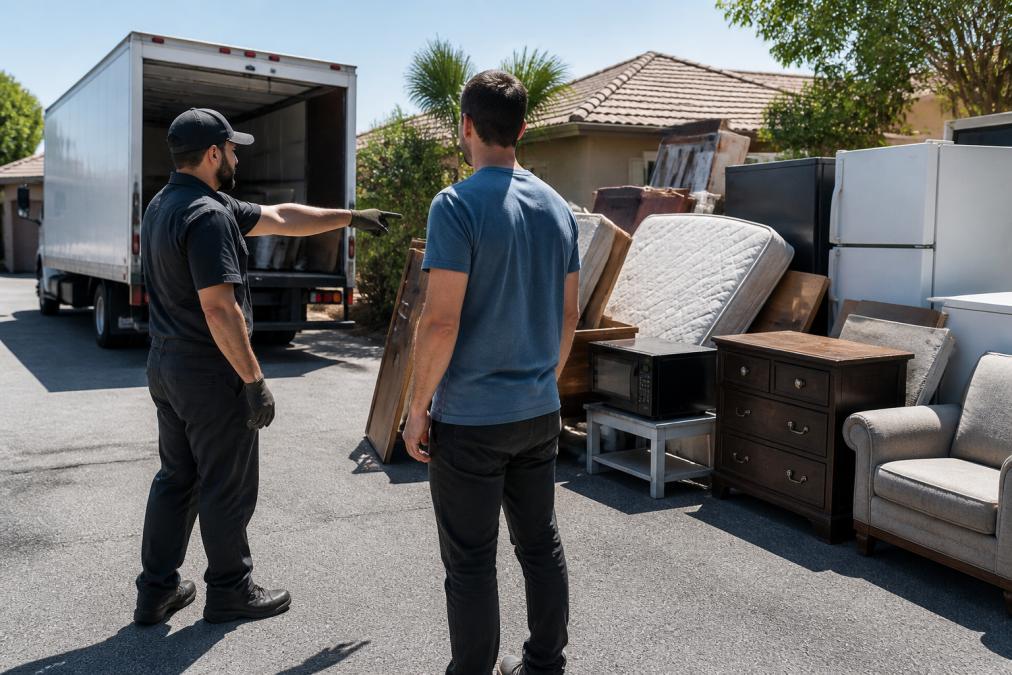
Preparation takes about 30 minutes and cuts your bill, because crews charge for volume and time. Sort first, consolidate second, and clear a path third.
- Separate keep, donate, and toss piles
- Confirm what the company accepts and what it won't take
- Drain refrigerators and freezers 24 hours ahead
- Remove personal items from drawers and cabinets
- Clear a path from the items to the truck
- Unlock gates and move vehicles out of the driveway
- Photograph the pile for an accurate remote estimate
Junk King vs 1800GotJunk: Comparing Two National Names
Independent operators often quote lower and book faster. Check whether the crew is licensed and insured, whether the quote is binding, and whether same-day service is actually available in your area rather than just advertised. For most residential jobs, local coverage and a firm quote beat a familiar logo.
How to Book Professional Junk Removal Services: Step by Step
Booking takes four steps and about ten minutes. The process is simple: describe the load, get a quote, pick a window, and confirm the details in writing.
- Describe your load. List the big items and rough volume. Mention appliances, mattresses, and anything heavy.
- Request a quote. Photo-based estimates work for most jobs; onsite estimates suit large or ambiguous piles.
- Choose an appointment window. Ask about same-day and next-day availability if timing matters.
- Confirm in writing. Get the price, the arrival window, and the accepted-items list in a text or email.
What to Look For When Comparing Junk Removal Companies
Four checks separate a reliable company from a cheap one. Verify licensing and insurance, confirm the quote is binding, ask where your items actually go, and read recent reviews for no-shows. Most of these are quick phone or website questions, and any company that hesitates on them is telling you something.
Insurance, Liability, and Who Pays When Something Breaks
This is the question almost no one asks and almost everyone should. When a crew carries a couch through your front door, three things can go wrong: the couch damages the doorframe, a worker gets hurt, or an item you wanted to keep gets hauled away by mistake. Each has a different answer, and the answer depends entirely on the company's coverage.
Ask for two things specifically:
- General liability insurance. This covers property damage, your walls, floors, doorframes, landscaping, and driveway. A crew without it means you're negotiating with the company directly, or filing a homeowner's claim, when something breaks.
- Workers' compensation coverage. If a worker is injured on your property and the company doesn't carry workers' comp, the injury can become your problem. This is the single most important coverage to confirm, and it's the one homeowners never think to ask about.
Where Your Items Actually Go
Eco-friendly disposal deserves its own question. Appliances contain refrigerants and metals that shouldn't hit a landfill, and appliance recycling programs exist specifically to recover them. Ask whether the company separates recyclables, donates usable furniture, or sends everything to the same transfer station.
The Business Reality Behind the Quote
On the business side, profitable operations target roughly 80 jobs per month to sustain 20% to 40% margins (BeanCount junk removal profitability analysis). That benchmark tells you something useful: a company quoting far below everyone else is either cutting corners on disposal or won't last the year. Disposal fees, insurance, fuel, and labor are fixed costs. A quote that ignores them isn't a bargain, it's a warning.
Frequently Asked Questions
What is the minimum charge for junk removal?
Most junk removal companies set a minimum pickup fee that covers a small load, such as a single couch or a few boxes. The exact minimum varies by provider and region, so ask for it upfront when you call. A reputable company will explain the minimum before booking, and some apply it toward the total if your load grows. Always request a written estimate so there are no surprises on pickup day.
Is it better to hire a junk removal service or rent a dumpster?
It depends on your project. Junk removal is better for one-time cleanouts, heavy items, and tight spaces because the crew does the loading and hauling. Dumpster rental works for multi-day renovations where you generate debris gradually. Junk removal also includes disposal fees and recycling, while dumpster rental often has weight limits and overage charges. For estate cleanouts or appliance removal, a full-service crew is usually the simpler choice.
What items are typically prohibited by junk removal services?
Most junk removal companies cannot take hazardous waste, including paint, motor oil, pesticides, asbestos, and lead-paint debris. Tires, medical waste, and ammunition are also commonly refused. Appliances with refrigerant, such as refrigerators and AC units, are accepted by many providers but may carry a small recycling fee. If you have questionable items, tell the dispatcher when you book so they can confirm what is allowed.
How do I prepare my home for a junk removal appointment?
Clear a path to the items, remove personal belongings from furniture, and separate anything you want to keep. Take photos of the pile so the company can give an accurate estimate. If items are in a basement or attic, mention stairs or tight turns when booking. On appointment day, make sure someone is home or leave clear access instructions. These steps keep the crew safe and speed up the pickup.