 how-to
What to Do With Old Mattresses: A 2026 Guide
Table of Contents
- Step 1: Decide If Your Mattress Can Be Donated or Must Be Disposed Of
- Step 2: Find Mattress Recycling Near Me: Drop-Off and Municipal Options
- Step 3: Learn How to Donate a Mattress to Charity or a Neighbor
- Step 4: Check Curbside Mattress Pickup Requirements Before You Set It Out
- Step 5: Hire Junk Removal Services for Furniture and Mattresses
- Step 6: Compare Costs: Recycling, Donation, Curbside, and Junk Removal
- Step 7: Try DIY Upcycling and Repurposing Before You Haul It Away
- Step 8: Follow Regional Disposal Laws to Avoid Illegal Dumping Fines
- Frequently Asked Questions
Last Updated: September 29, 2026
Step 1: Decide If Your Mattress Can Be Donated or Must Be Disposed Of
Most people haul old mattresses to the curb before asking one question: is it still good enough to give away? That single decision changes everything about what to do with old mattresses. A clean, undamaged mattress can find a new home. A stained one usually cannot.
Sanitation and Hygiene Standards Donation Centers Check
Charities reject mattresses with visible stains, odors, or signs of bed bugs. Most also refuse mattresses without a manufacturer's law tag, since that tag proves the mattress meets federal flammability rules.
Structural Damage and Pest History That Rule Out Donation
Sagging, broken springs, and torn fabric end the donation conversation fast. So does any history of pests, even if the problem was treated months ago.
- Sagging or soft spots that never recover
- Broken or poking springs felt through the fabric
- Tears, burns, or water damage on the cover
- Any past bed bug or rodent activity
Step 2: Find Mattress Recycling Near Me: Drop-Off and Municipal Options
Searching for mattress recycling near me usually turns up two things: a municipal drop-off site or a private recycling facility. Both keep your mattress out of a landfill, which matters because mattresses are bulky and slow to break down.
Step 3: Learn How to Donate a Mattress to Charity or a Neighbor
If you want to know how to donate a mattress, start with local charities rather than national chains. Many national organizations stopped accepting used mattresses years ago over hygiene and liability concerns.
Step 4: Check Curbside Mattress Pickup Requirements Before You Set It Out
Curbside mattress pickup requirements vary widely, and skipping this step is how people end up with a violation notice. Some cities take mattresses with regular trash. Others require a scheduled bulk item pickup. Many charge a separate fee.
- Does your hauler accept mattresses at all?
- Do you need to schedule the pickup in advance?
- Must the mattress be wrapped in plastic?
- Is there a tag or sticker you have to buy first?
Step 5: Hire Junk Removal Services for Furniture and Mattresses
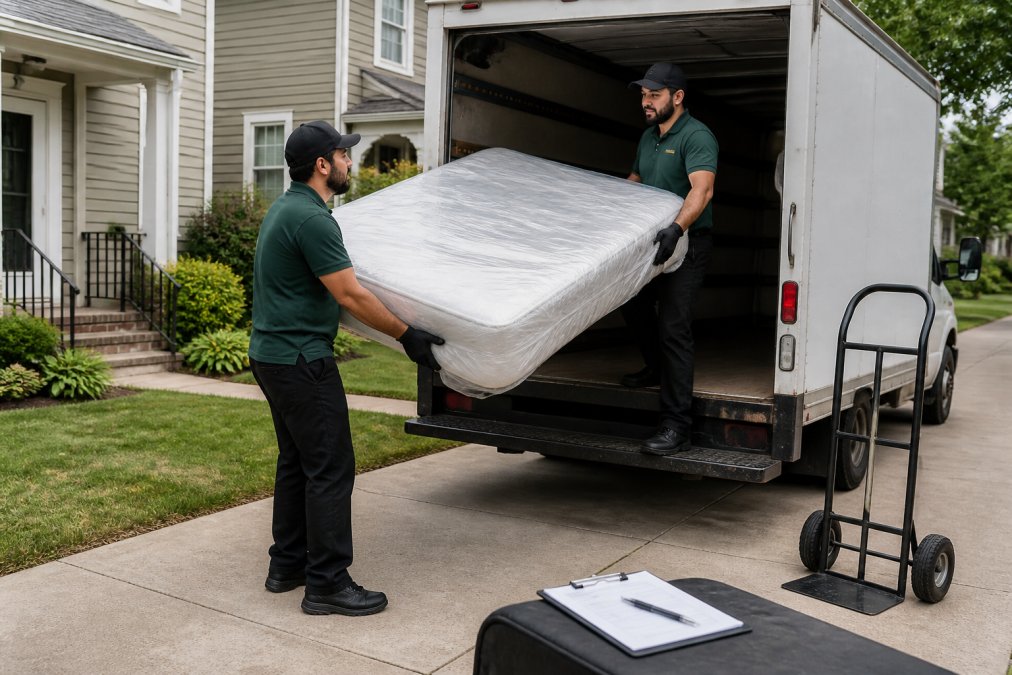
Junk removal services for furniture solve the problem when you have no truck, no time, or no patience. You point at the mattress, and it disappears. That convenience is the entire product.
Step 6: Compare Costs: Recycling, Donation, Curbside, and Junk Removal
The cheapest option on paper is rarely the cheapest option overall. The table below breaks down the four main routes by what you actually pay, what you actually do, and when each one wins.
| Option | Typical Upfront Cost | Time and Effort | Hidden Costs | Best For |
|---|---|---|---|---|
| Recycling drop-off | Varies by program; some state programs are free, others charge a per-unit gate fee | You load, haul, and unload | Fuel, vehicle wear, a second trip if the site rejects it | One or two mattresses, flexible schedule, access to a truck |
| Donation | Free | You haul and pass inspection | Fuel and time if rejected at the door | Clean mattresses with a law tag and no stains |
| Curbside or bulk pickup | Often a flat per-item fee or a sticker/tag purchase; some haulers include it in base service | Low, but you must follow scheduling and wrapping rules | Fines for setting it out wrong or early | Single mattresses, patient owners, no truck |
| Junk removal | Quote-based, usually priced by volume, weight, or truck space | Almost none | None if the quote is honored | Bulk cleanouts, tight deadlines, no truck or no time |
How to Run the Real Math on a "Free" Option
A free donation can cost you a tank of gas and half a Saturday. If the charity rejects the mattress at the door because of a stain or a missing law tag, you have spent both for nothing and still own the mattress.
Here is a simple way to compare:
- Count the units. One mattress is a chore. Five mattresses from a rental turnover is a logistics problem.
- Estimate your round trip. Multiply your fuel cost by the number of trips you may need, including a possible rejection trip.
- Value your time. If the drop-off and return take three hours, that is three hours you are not doing something else.
- Add the gate fee or tag cost. Many municipal programs charge a per-unit fee or require a purchased sticker before pickup.
- Compare against a single quoted haul. One quote that covers every unit in one visit often beats four separate trips once fuel and time are counted.
When the Math Flips Toward Junk Removal
For a single clean mattress and a free Saturday, self-haul or donation usually wins. For a rental turnover, an estate cleanout, or a household replacing several beds at once, the per-unit cost of doing it yourself climbs fast because every unit adds another trip.
The Cost of Getting It Wrong
Illegal dumping fines can run into the hundreds of dollars, and a violation notice from your hauler or municipality can add fees on top of the original disposal cost. A free option that turns into a fine is the most expensive option on this list. When in doubt, pay for the documented path and keep the receipt.
Step 7: Try DIY Upcycling and Repurposing Before You Haul It Away
Not every old mattress needs to leave the house. Repurposing keeps materials in use and saves you a trip, which is the heart of the circular economy in practice.
A few ideas that actually work:
- Pet beds: Cut a section of foam, wrap it in a washable cover, and you have a dog bed.
- Moving pads: Foam layers protect furniture during a move.
- Sound dampening: Foam panels cut down echo in a garage or workshop.
- Gardening: Some foam works as drainage layer in large planters.
Step 8: Follow Regional Disposal Laws to Avoid Illegal Dumping Fines
Disposal rules are set at the state and local level, and they differ enough that advice from a friend in another state can get you fined. Here is how to figure out what actually applies to you.
The Three Layers of Rules That Apply to a Mattress
- State law. A handful of states run mattress stewardship or recycling programs funded by a fee collected at the point of sale. California's program is the best known, and it funds free or low-cost drop-off and recycling across the state. Other states have passed similar stewardship laws, and the list changes as new laws take effect, so verify the current status for your state rather than assuming.
- County or municipal rules. Your waste authority decides whether mattresses go out with regular trash, require a scheduled bulk pickup, or are banned from the landfill entirely. This is where most of the practical rules live: scheduling windows, wrapping requirements, tag purchases, and per-item fees.
- Hauler rules. Even where the city allows curbside mattresses, your contracted hauler may refuse them, require plastic wrapping, or limit you to one bulk item per pickup. The hauler's rules control what actually gets collected.
How to Find Your Rules in Under Ten Minutes
- Search your county or city waste authority website for "bulk item pickup" and "mattress disposal."
- Look for a mattress-specific page, since many agencies bury the rules under bulky waste.
- Check whether your state runs a stewardship program by searching your state name plus "mattress recycling program."
- Call your hauler directly and ask three questions: Do you take mattresses curbside? Do they need to be wrapped? Is there a tag or fee?
- If you rent, check your lease or ask your property manager, because many multifamily buildings have separate bulk pickup arrangements.
Why "Just Leave It in the Alley" Is a Bad Plan
Illegal dumping fines can run into the hundreds of dollars, and some jurisdictions treat repeat offenses more harshly. Beyond the fine, a mattress left on the curb outside a pickup window can be tagged by a code enforcement officer, and in some cities the property owner, not the person who dumped it, is the one cited.
The Safest Path Is the Documented One
A scheduled pickup, a permitted drop-off, or a licensed hauler all leave a paper trail. That trail protects you if anyone questions where the mattress went, and it is the difference between a clean disposal and a citation.
Frequently Asked Questions
What is the best way to dispose of a mattress?
The best method depends on condition. A clean, structurally sound mattress can be donated to a local charity or listed for free pickup. If it is stained, sagging, or has pest history, recycling is the next best option because up to 80 percent of a mattress by weight can be recovered. Curbside bulk pickup works if your municipality offers it, and junk removal services for furniture are the most convenient route when you need the mattress gone quickly.
Can I donate a used mattress to charity?
Many charities accept mattresses only if they are free of stains, tears, and odors, and sometimes require a mattress protector or original law tag. Call ahead to confirm current policy because donation centers change rules often. If a charity declines, try listing it on a local free-exchange group with clear photos and measurements. Some organizations also schedule collection events where you can drop off bedding materials for reuse or recycling.
How do I prepare a mattress for curbside pickup?
Most curbside mattress pickup requirements ask you to wrap the mattress in plastic sheeting to keep it dry and prevent pests, remove it from any bed frame, and place it at the curb by 6 a.m. on your scheduled day. Some cities require you to schedule the pickup in advance and limit you to one bulk item per month. Check your municipal services website for exact rules, including whether you need to tag the mattress or pay a disposal fee.
What is the most eco-friendly way to dispose of a mattress?
Recycling is the most eco-friendly option because it diverts polyurethane foam, steel springs, and textile recycling streams from landfills. Look for a mattress recycling near me search to find a drop-off location or a collection event. If recycling is not available, donation extends the mattress life cycle. Repurposing the mattress into pet beds, moving pads, or garden row covers also keeps components out of the waste stream and supports a circular economy.
Old mattresses are awkward, heavy, and easy to put off until they become a problem. Whether you donate, recycle, or schedule a pickup, the goal is the same: get it gone the right way.
Slash Trash Hauling makes that last step simple. We remove unwanted furniture, appliances, and demolition debris from homes, rentals, and job sites. No sorting, no hauling, no guessing about fees. Get a quote from Slash Trash Hauling and clear that mattress out of your way for good.